
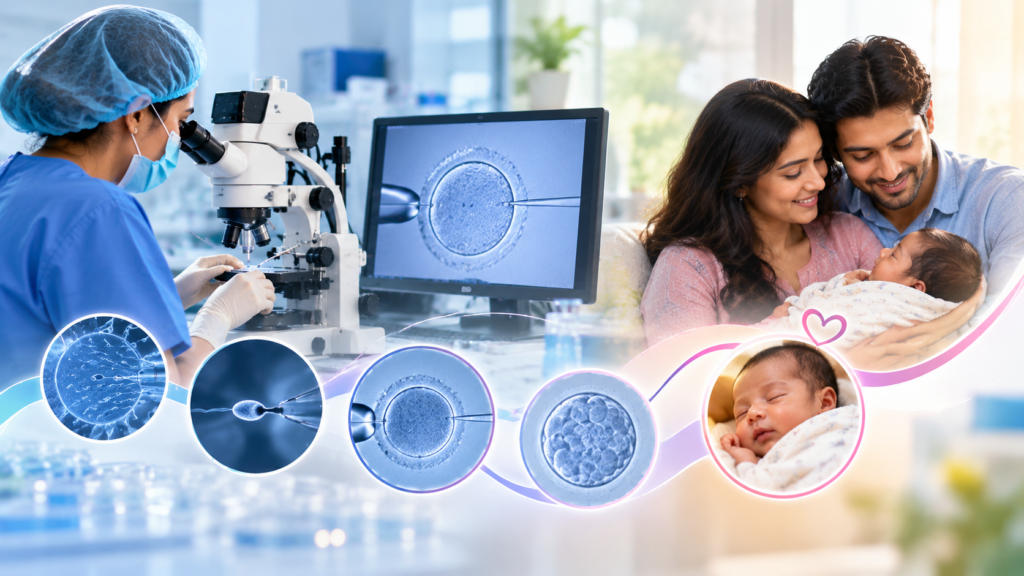
Some of the biggest moments in a fertility journey begin at a scale that cannot be seen with the naked eye. Inside an embryology laboratory, highly specialised equipment and careful scientific techniques can assist the fertilisation process. One such technique is ICSI, or intracytoplasmic sperm injection.
For couples visiting a Fertility Centre in Junagadh, understanding what happens during ICSI can make an advanced fertility treatment feel less complicated and more understandable. While the procedure itself takes place at a microscopic level, the decision surrounding it deserves clear, personalised medical guidance.

What Exactly Is ICSI?
ICSI stands for intracytoplasmic sperm injection. It is a specialised laboratory technique generally used as part of an IVF treatment cycle.
During conventional IVF, prepared sperm and an egg are placed together under controlled laboratory conditions, allowing fertilisation to occur naturally in the laboratory environment. With ICSI, an embryologist uses specialised microscopic equipment to inject one selected sperm directly into a mature egg.
At the best IVF center in Junagadh, couples can discuss whether this technique has a role in their particular treatment plan.
Why Might ICSI Be Considered?
ICSI is not automatically necessary for everyone undergoing IVF. Its use depends on individual circumstances and the advice of the treating fertility specialist.
ICSI treatment in Junagadh may be considered when certain sperm-related factors could make conventional fertilisation more challenging. It may also be discussed when there has been a previous IVF cycle with unexpectedly low or unsuccessful fertilisation.
Other clinical circumstances may influence the decision as well. The important point is that ICSI should be considered based on the couple’s medical situation rather than simply because it is an advanced technique.

The Journey of an Egg Before ICSI
Before the laboratory procedure begins, fertility treatment usually involves ovarian stimulation and monitoring so that multiple eggs may develop. When appropriate, eggs are collected through an egg retrieval procedure.
The collected eggs are then assessed in the embryology laboratory. Only mature eggs are suitable for ICSI.
This careful preparation is one reason laboratory expertise matters at a Fertility Centre in Junagadh. Every stage requires attention to timing, handling, and laboratory conditions.
What Happens Under the Microscope?
The actual ICSI procedure is remarkably precise.
An embryologist carefully holds the mature egg in position using specialised equipment. A very fine injection pipette is then used to introduce a single selected sperm into the egg’s cytoplasm.
The objective is to place the sperm directly inside the egg, bypassing the need for the sperm to penetrate the egg on its own.
For couples considering ICSI treatment in Junagadh, understanding this microscopic step can help explain why ICSI is considered a specialised laboratory procedure rather than simply another type of fertility medication.
What Happens After Injection?
ICSI does not end when the sperm has been injected. The eggs are monitored in the laboratory to determine whether fertilisation has occurred.
If fertilisation takes place, the resulting embryos may continue developing under carefully controlled laboratory conditions. Embryologists monitor their development and provide information to the clinical team.
At the best IVF center in Junagadh, the subsequent treatment decisions depend on individual circumstances, embryo development, medical considerations, and the treatment plan established by the fertility specialist.

ICSI Is Not a Guarantee
One of the most important things couples should understand is that ICSI assists the fertilisation process, but it cannot guarantee fertilisation, embryo development, implantation, or pregnancy.
There are several stages between fertilisation and pregnancy, and each stage can be influenced by different biological factors.
A responsible Fertility Centre in Junagadh should explain both the potential benefits and the limitations of the technique so couples can make informed decisions without unrealistic expectations.
Choosing Information Along With Treatment
Advanced fertility care can involve unfamiliar procedures, laboratory terminology, and many decisions. Asking questions can make the process easier to understand.
Couples considering ICSI treatment in Junagadh may wish to discuss why ICSI has been recommended, whether conventional IVF is an alternative, what the laboratory process involves, and how the treatment fits into their overall fertility plan.
At the best IVF center in Junagadh, these conversations can help connect sophisticated reproductive technology with personalised medical care.
A Tiny Procedure Within a Much Bigger Journey
ICSI begins with a microscopic interaction between an egg and a sperm, but for couples experiencing infertility, it can represent an important part of a much larger treatment journey.
The role of a Fertility Centre in Junagadh is not simply to provide advanced technology. It is also to evaluate each couple carefully, explain available options, and guide them through decisions with realistic expectations.
When ICSI treatment in Junagadh is being considered, understanding the science behind the procedure can replace uncertainty with knowledge.
Because sometimes a life-changing chapter begins with something remarkably small—a single sperm, a single egg, and a highly precise moment inside the laboratory.